Michigan State University campus
Silent SpringMichigan State University campus became both a research setting and a measure of ecological damage: as spraying spread across the grounds, the robins being studied by graduate researcher John Mehner dwindled until the campus functioned as a lethal trap. The change made an ordinary university landscape a place where pesticide exposure could be traced through migration, feeding, and failed reproduction.
Research and the First Spraying
When Mehner began doctoral research on robin populations in 1954, he had no reason to expect that the birds were in danger. The project’s subject changed around him. That year, Dutch elm disease spraying began on a small scale on the campus; the following year, East Lansing joined the campaign, spraying on campus expanded, and local programs for gypsy moths and other pests added to the chemical pressure.
The campus was not simply a backdrop to Mehner’s research. Its changing treatment altered the population he had chosen to study and threatened to deprive him of his material. The sequence joined two kinds of activity in one place: an attempt to observe wildlife and a program of management that was transforming the conditions of wildlife’s survival.
A Lethal Passage for Robins
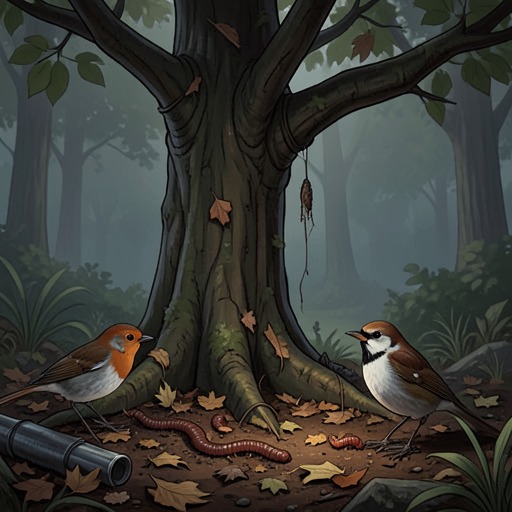
The effects appeared in the robins’ ordinary behavior as well as in their numbers. Few birds were seen foraging normally or gathering at their customary roosts. Few nests were built, and few young appeared. In successive springs the pattern repeated: each wave of migrating robins entered the sprayed area and was eliminated in about a week, after which new arrivals came through the same danger.
The campus thus became a recurring hazard rather than a one-time site of mortality. Migration replenished the birds exposed to the spray, but did not restore a lasting population. The regular return of robins made the damage visible over time, while the near absence of feeding, roosting, nesting, and young showed that the consequences extended beyond immediate deaths.
The Missing Young
The collapse of reproduction could be counted against the population that had existed before spraying. In 1957, Mehner found only one young robin on campus, where at least 370 young birds—the normal replacement for the adult population—would have been expected in the pre-spraying years. The next spring, George Wallace reported that he had seen no fledgling robin anywhere on the main campus during the spring or summer of 1958, and had found no one else who had seen one there.
Those absences mark the campus’s significance in the book’s account: a place where a research project became a sustained record of ecological disruption. The contrast between the expected 370 young birds and the single bird found in 1957, followed by Wallace’s report of none in 1958, makes the damage legible not as an isolated incident but as a failure of renewal.